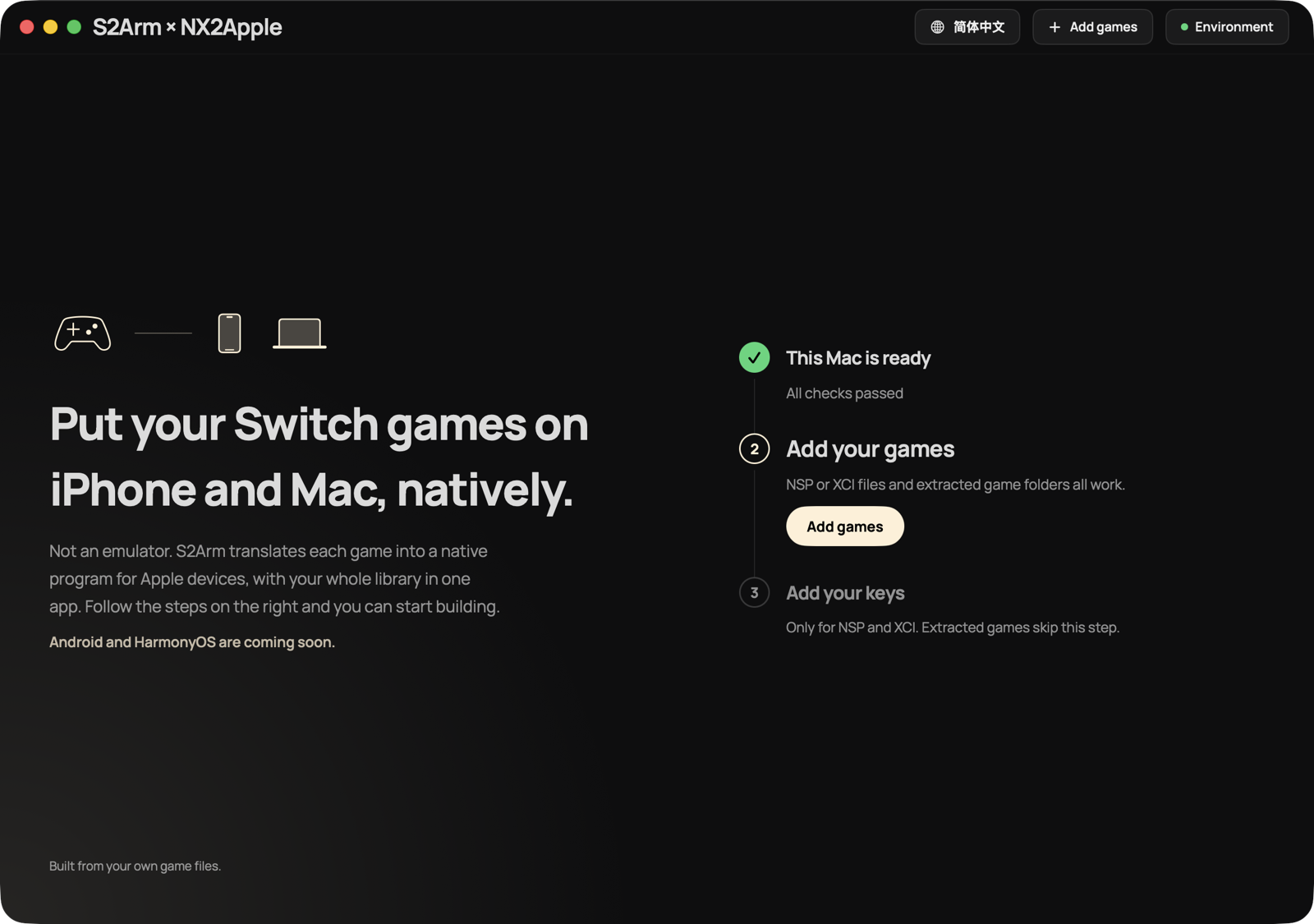
S2Arm's latest update addresses a problem that rarely makes game-porting highlight reels: a Mac becoming unresponsive while preparing native builds for an iPhone. The developer released S2Arm 0.5.3 on November 17, 2026, at 13:08 UTC, with memory safeguards for background jobs, more reliable Apple device installation and several controller fixes. For people already experimenting with their own Switch games on Apple hardware, those are more practical changes than another unqualified speed claim.
According to the official v0.5.3 release notes, the launcher now serializes work it previously performed automatically in the background and adjusts parallel build activity to available memory. This is a fix aimed at a real bottleneck: getting the game prepared without making the host Mac unusable.
A launcher that no longer tries everything at once
The S2Arm Mac launcher can prepare an updated iPhone app and apply extra game optimizations after opening. Those jobs previously competed for resources. On a machine short of free RAM, they could cause heavy paging, a frozen desktop or a restart, the maintainer says.
Version 0.5.3 moves those tasks into a one-at-a-time, low-priority workflow and caps simultaneous packaging work according to free system memory. The developer also changed how unaligned game-resource files are processed, avoiding reading whole large files into memory just to package them. These are host-side memory-management improvements, not measurements proving that Switch games suddenly run at a higher frame rate.
That distinction matters because compilation and play are different workloads. A laptop may be able to run a prepared game but struggle to assemble an app from large resource archives while other programs are open. The new behavior is intended to make setup more predictable, particularly on Macs with modest memory.
Free Apple ID installs get a provisioning repair
Players installing an app on their own iPhone with a free Apple ID could hit error 0xe8008015, which reports that a valid provisioning profile was not found. The 0.5.3 release tightens profile selection: it skips expired profiles and those that do not cover the attached device, then requests a qualifying one. If the phone still rejects the app, S2Arm makes one additional attempt to create the needed profile before retrying.
This is not a promise to circumvent Apple's signing rules. The workflow still needs a valid account and device authorization. It simply handles a common failure more carefully rather than sending a package with the wrong local signing profile.
The launcher now checks the iPhone's available storage before transfer, too. Insufficient space should produce a space-related warning rather than a misleading connection error. Incomplete game-resource packages are also rejected before gameplay starts, turning what could look like a mysterious in-game crash into an actionable setup message.
Controller fixes matter for couch and handheld play
There are several concrete input changes. Wired Xbox controllers are now supported natively on Mac. The controller's position in the Mac panel determines its player number in a game, including after swapping devices. On some Pro-style pads where factory calibration cannot be read, the end of the stick's physical travel is now treated as full input.
On iPhone, using a Nintendo Switch 2 Pro controller alongside another system controller should no longer disable the Pro pad. This is a narrower fix than universal controller compatibility, but it matters when users combine handheld and external inputs.
The update also refines the mod import interface and, on macOS, exposes an Install on Apple TV option for compatible game builds already prepared for that device. Apple TV support remains an early preview limited to the Mac workflow.
What S2Arm actually does
S2Arm describes itself as a native code-translation project, not a conventional emulator. The official project overview says it rewrites code from games users legally own into ARM64 code ahead of execution and maps graphics operations to Metal. Its graphical launcher can run on Mac or Windows to prepare an iPhone or iPad package; an Apple-silicon Mac can also host games locally.
Its stated minimum platform targets include iOS/iPadOS 18 and macOS 15 on Apple silicon. Android and HarmonyOS support are listed as future work, not as features delivered by 0.5.3. The project makes broad compatibility and performance claims in its own documentation, but those claims are not independent benchmarks from this release.
No game files are included in S2Arm. Its code and launchers being open source does not make Nintendo games, encryption keys or game resources freely distributable. Owners must follow the applicable licensing and device rules, and players should back up saves before switching builds.
The update is mostly about trust in the setup process
A native porting project can sound impressive on paper and still lose users at installation. Today's changes target precisely that friction: runaway memory use, unreliable signing, misleading errors, controllers that change player assignment and resource packs that fail late.
The developer has not published independent evidence that every Mac memory freeze or iPhone signing failure is gone. The sensible assessment is narrower: 0.5.3 is a substantial reliability release for S2Arm's launcher and Apple-device workflows. If an older version stalled during packaging or showed 0xe8008015, the project's official download and issue tracker are the appropriate next places to check. The screenshots accompanying this story show the project's launcher workflow, not a before-and-after benchmark of the patch.
Source date: November 17, 2026