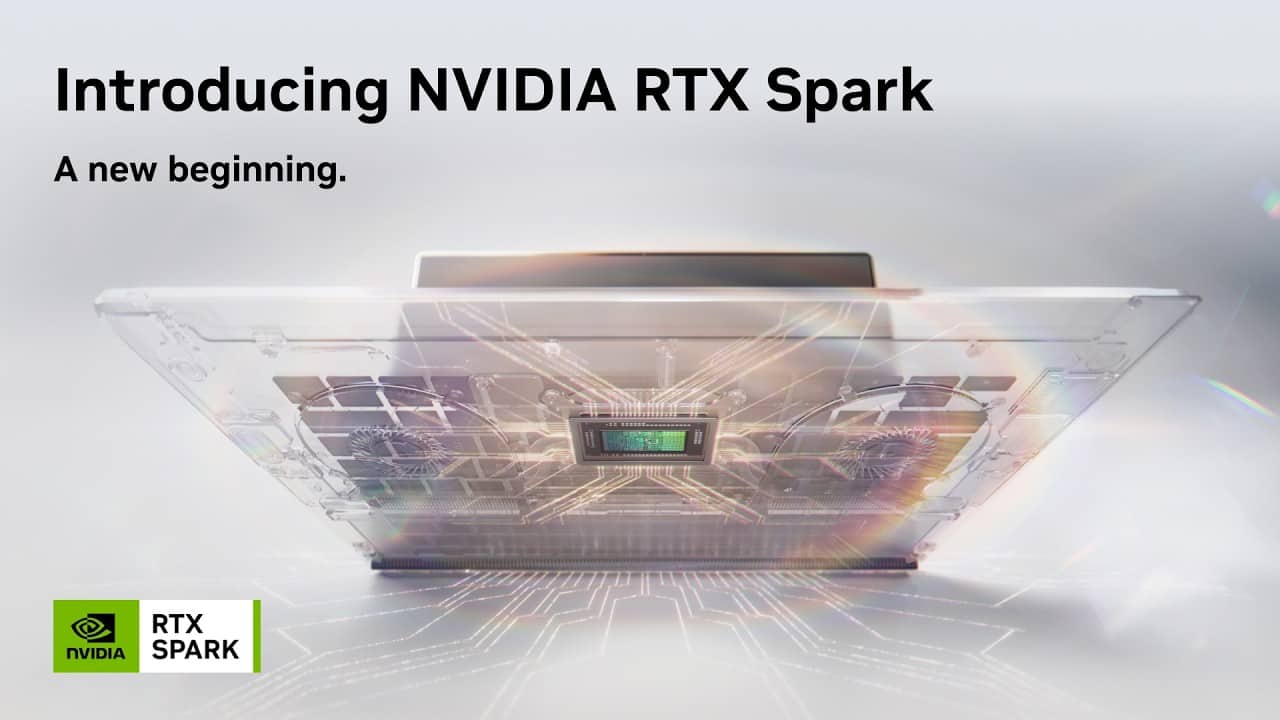
NVIDIA's RTX Spark Windows PCs can now run Underdog Desktop Agent locally, while the company is preparing a 64GB DGX Spark configuration for Friday, October 23, 2026. Announced during GTC Berlin on October 21, the updates also expand NVIDIA Sync, add a new local coding model, and point to more ways of running AI without sending every request to a cloud server.
The important distinction is that RTX Spark and DGX Spark are not the same product. RTX Spark is NVIDIA's new Windows platform for creators, gamers and personal agents; DGX Spark is a Linux-based developer system that can be combined into a larger local AI cluster. NVIDIA's latest news gives both groups new software and hardware choices, but it does not mean every model will run on every PC.
What's new for NVIDIA RTX Spark in October?
RTX Spark laptops began shipping on October 16. NVIDIA used its October 21 GTC Berlin update to focus on what owners can actually do with the machines.
The headline addition is Underdog Desktop Agent, a downloadable application designed for local AI work. NVIDIA says it uses Underdog's Husky inference engine and executes supported AI models entirely on the device. That architecture can keep the underlying model processing and user data on the PC instead of routing routine inference through a hosted service.
However, an offline model does not automatically make an entire workflow offline. Search, messaging or another external integration may still use the internet. Users should review an agent's connected tools and permissions before allowing it to act on files, browser sessions or private accounts.
NVIDIA also says many RTX Spark laptop designs have unlocked bootloaders, giving developers and enthusiasts more control over their machines. That does not imply that every manufacturer's model has identical firmware options or support policies.
What hardware does RTX Spark offer?
RTX Spark combines NVIDIA Blackwell RTX graphics and a Grace CPU architecture in premium Windows 11 laptops and compact PCs. The company's October 16 launch announcement advertises up to 128GB of unified memory and up to one petaflop of FP4 AI compute.
Those numbers describe the top-end platform and a particular low-precision AI workload, not the amount of conventional dedicated GPU VRAM or the performance of every model. In a unified-memory design, the CPU and GPU can access a shared pool, which may help with models too large for typical gaming-card memory configurations.
Laptop starting prices were reported by NVIDIA at $2,399 during launch week. Individual systems from ASUS, Dell, HP, Lenovo, Microsoft and MSI differ in configuration, cooling and price. NVIDIA's performance claims should be checked against reviews of the specific laptop and task rather than taken as a universal result.
The official NVIDIA video below introduces the RTX Spark hardware and its vision for local AI on Windows; it predates the October 21 software announcements.
DGX Spark 64GB release date: October 23
The other major piece of the Berlin announcement concerns DGX Spark, NVIDIA's compact Linux-based AI development system. A new 64GB unified-memory version is scheduled to start rolling out on October 23 through partners including Acer, ASUS, Dell Technologies, GIGABYTE, HP and MSI.
NVIDIA positions the 64GB option for running developer workloads and local models without always using a remote service. Its October 21 post names examples such as Nemotron 3.5 Bolt 74B in its 24GB format, Qwen3.8 27B and Gemma 4 26B-A4B.
This does not establish a guaranteed performance figure for every workload. Actual memory consumption depends on model weights, context length, KV cache, runtime and other applications.
The 64GB product should not be confused with the larger-memory DGX Spark configurations, and NVIDIA's October 21 post does not specify one universal retail price for all partners' 64GB systems.
NVIDIA Sync now supports larger local AI clusters
Owners of DGX Spark systems have another option: connecting several machines to share work. NVIDIA says NVIDIA Sync Cluster Assistant now supports a manual configuration of up to eight DGX Spark units.
The company highlights the potential for as much as 1TB of unified memory with eight appropriately equipped units, enabling larger models, longer working contexts and multiple simultaneous agents. This is a cluster-wide capacity figure, not a claim that one program automatically receives a single seamless terabyte of memory.
A new NVIDIA Sync Model Launcher is also planned for later in October. NVIDIA says it will simplify downloading a model and selecting a suitable container, then connecting it to OpenCode. That should make the first setup easier, but it does not eliminate the need to understand model licenses, hardware limits or security settings.
An October DGX Spark software update also adds a Wi-Fi Assistant for systems running in appliance mode and improves task-focused maintenance guidance through DGX Spark Skills.
New coding models and what developers should watch
At GTC Berlin, NVIDIA also highlighted Recursive Flint, a new 40-billion-parameter mixture-of-experts coding model built for local development. The developers say it activates about 2.5 billion parameters per token, rather than all 40 billion, to reduce inference work.
Recursive has published Flint's official model announcement and open weights under Apache 2.0. NVIDIA reports that Flint is available for local NVIDIA hardware, while published speed demonstrations depend on specific configurations and runtimes. These are vendor benchmarks rather than a promise about ordinary gaming GPUs.
For developers choosing hardware, three questions matter more than a single peak tokens-per-second figure: whether the model fits into available memory, whether the runtime supports it, and whether it can solve the team's actual coding tasks accurately.
A Windows RTX Spark laptop, a single DGX Spark and an eight-unit Linux cluster answer very different needs. Buying the most memory does not automatically create the best development workflow.
Should gamers and AI enthusiasts upgrade?
RTX Spark is pitched as a combined gaming, creation and AI platform, and NVIDIA claims support for modern RTX features and major games. But a buyer interested primarily in gaming should compare actual frame rates, battery life, thermal limits and prices against conventional laptops with discrete GeForce graphics.
For someone experimenting with private assistants or local coding tools, unified memory and a supported local software stack may matter more. The case is strongest when workloads repeatedly need large models or private processing; occasional AI users may find a conventional PC plus cloud services more economical.
The bottom line: RTX Spark's new offline agent and DGX Spark's upcoming 64GB option make local AI more accessible, but they serve different audiences. The official GTC Berlin release confirms the October 21 software announcements and October 23 rollout target. Independent hardware tests will determine how much practical value these systems deliver beyond their headline specifications.
Confirmed details first, useful context second. This is the quickest path to the source trail and the next pages worth opening.
Source date: October 21, 2026