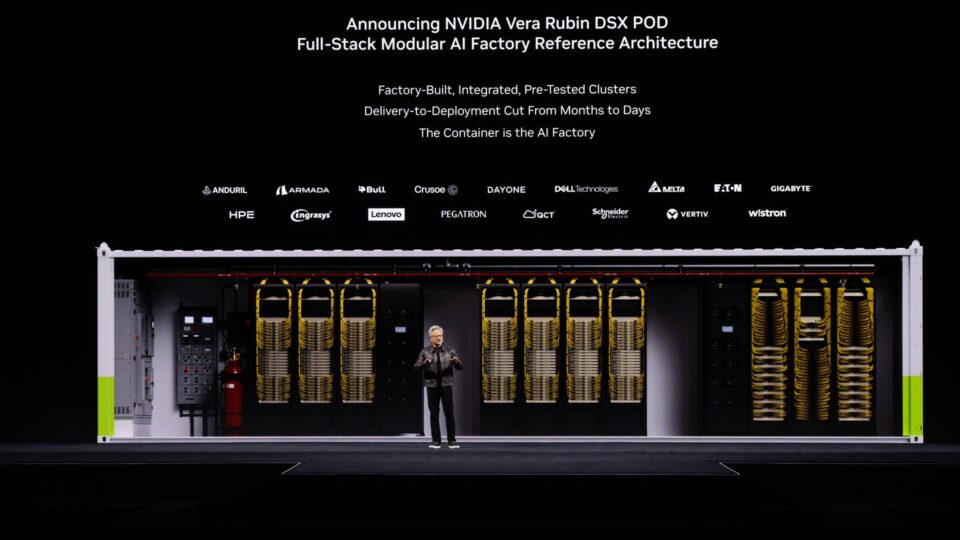
NVIDIA unveiled DSX POD at GTC Berlin on October 21, 2026, promising to shorten deployment of certain large AI data centers from roughly six months to as little as 14 days at a prepared site. The key is not a miraculous new GPU: it is a factory-integrated design that arrives with much of the computing, networking, power distribution and liquid-cooling integration already completed. NVIDIA and its manufacturing partners expect to deliver DSX POD-based systems worldwide in early 2027.
That distinction matters. The 14-day figure is NVIDIA's projected deployment scenario, not a guarantee that an organization can order a container today and run a massive AI cluster two weeks later. Here is what the announcement actually says, what remains to be built, and why AI infrastructure providers are interested.
What is NVIDIA DSX POD?
DSX POD is a reference design for a modular AI factory built around NVIDIA's Vera Rubin computing platform. Partners use that design to assemble systems inside purpose-built transportable containers, verify that the major components work together and then move the modules to a customer's location.
An AI factory is NVIDIA's name for infrastructure designed to run demanding AI workloads, including model training and production inference. Unlike a conventional server purchase, these installations depend on the interaction of dense computing hardware, fast internal connections, extensive power delivery, cooling and operational software.
The official NVIDIA announcement describes DSX POD as a way to move much of the installation work away from the customer's building site and into a manufacturing environment. It is a design that partners implement, not a single consumer product or a downloadable software update.
How can a data center become operational in 14 days?
The speed claim is largely about doing work in parallel instead of waiting for one construction phase to finish before starting the next.
What happens before delivery
According to NVIDIA's engineering explanation, partners can complete significant integration work in a factory, including:
- Fitting the rack-scale computing and networking components into the modular structure.
- Installing and checking rack-to-rack cabling, power connections and liquid-cooling piping.
- Validating mechanical, electrical, thermal and network requirements before shipment.
- Repeating a standardized design rather than resolving every integration decision on the customer's site.
While those tasks are happening, the eventual operator can prepare the location and its utilities. The point is to reduce the specialized on-site work required once the module arrives.
What the 14-day number does not include
The headline figure applies to deployment at a prepared site. A site still needs suitable electrical capacity, cooling and water connections where required, network access, physical space and the appropriate permissions.
NVIDIA itself notes on its DSX POD product page that the design does not eliminate on-site preparation. A company starting with an undeveloped plot of land should not interpret the announcement as a promise to finish permitting, construction, grid connections, shipment and commissioning within two weeks.
There is another important qualification: NVIDIA has announced a reference design and a partner delivery plan, rather than published independent field results demonstrating that every DSX POD installation will meet the minimum timeline.
Why use Vera Rubin in a factory-built container?
Vera Rubin is NVIDIA's AI computing platform for large-scale training and inference. DSX POD addresses a different part of the challenge: how to assemble and activate that capacity reliably.
Deploying more GPUs does little good if the networking, cooling or power system cannot support them. Integrating the equipment before shipping can make failures and mismatched components easier to detect under controlled conditions, though shipping and operating a high-density modular system still present significant engineering demands.
The potential benefit is therefore operational as much as computational. Bringing a system into service earlier could mean providing inference capacity and producing billable AI output sooner. NVIDIA calls this reaching the first production token — the point at which infrastructure begins doing useful model work, rather than merely occupying space.
For customers, the relevant question is not just how fast a container arrives. It is whether the whole installation, including the prepared site and application software, can begin serving real workloads reliably.
Release window: when can customers buy DSX POD?
NVIDIA says it is working with a global group of partners to deliver modular AI factories in early 2027. Named companies include Dell Technologies, HPE, Lenovo, Schneider Electric, Vertiv, Bull and other infrastructure specialists.
The October 21 release does not provide a universal retail price, customer order page or guaranteed delivery date for individual installations. Different partners may supply and support different configurations, and NVIDIA positions DSX POD primarily for organizations building large-scale, liquid-cooled AI infrastructure.
The announcement was made in Berlin, but the stated partner rollout is worldwide. Organizations evaluating a deployment will still need to discuss site specifications, equipment availability, service responsibilities and commercial terms with a participating supplier.
Why the announcement matters beyond the data center industry
AI models are increasingly limited not only by accelerator availability but also by how quickly a usable cluster can be assembled, connected and operated. A faster, standardized installation process could help cloud providers add capacity with less construction uncertainty.
That does not automatically mean cheaper AI subscriptions or instant relief from computing shortages. Pricing depends on electricity, financing, utilization, networking, software, competition and many other costs. Nor does NVIDIA's projected schedule prove that containerized designs will work for every power density or climate.
For developers and businesses planning AI workloads, the practical implications are worth watching:
- Actual deployments: Which partner delivers a production DSX POD first, and how long does commissioning really take?
- Site prerequisites: How much power, networking and cooling must exist before the advertised deployment clock starts?
- Reliability: How do transported, integrated modules perform under sustained training and inference loads?
- Economics: Does faster activation translate into better usable capacity or lower total cost over time?
Independent reporting from Data Center Knowledge and Data Center Dynamics confirms the broader announcement while reinforcing that the timeline originates with NVIDIA.
The bottom line
NVIDIA DSX POD is a faster-deployment strategy for industrial-scale AI hardware, not a 14-day shortcut around building a data center. Its standardized, factory-tested Vera Rubin modules are intended to reduce work after arrival at a prepared location. The next meaningful proof will come from partner installations in 2027: measured commissioning time, sustained operational performance and actual customer costs.
For now, the 14-day figure is an ambitious NVIDIA claim with clear conditions — and those conditions matter just as much as the headline.
Confirmed details first, useful context second. This is the quickest path to the source trail and the next pages worth opening.
Source date: October 21, 2026