The Volatile New Frontier of Cinis
Ubisoft has confirmed that the city-building sequel, Anno 117: Pa Romana, is receiving its first major expansion, Prophecies of Ash. This DLC fundamentally alters the scope of the game by introducing Cinis, a massive volcanic island that serves as an expansion to the Latium province. This development immediately raises the stakes for players, moving the focus from purely logistical expansion to one defined by environmental risk. The sheer scale of Cinis, described as the largest island featured in the series, suggests a significant overhaul of the map and the player's interaction with the Roman world. It is not merely a new map, but a volatile addition that forces players to build not just for prosperity, but for survival.
The immediate changes are visible in the resource pool and the available building opportunities. The trailer footage and accompanying press details confirm that Cinis is a remarkably bountiful location, boasting plentiful river slots and rich mining nodes. This abundance is coupled with the introduction of a brand-new resource: Obsidian. This material is not just decorative; it is central to the game’s new cultural and economic loops, allowing players to fashion specialized items such as carved idols and complex boardgames. The necessity of establishing entire production chains dedicated to Obsidian production means that resource management must now account for specialized, high-value goods alongside basic foodstuffs and construction materials. This shift ensures that the DLC provides immediate, tangible economic depth, rewarding players who can efficiently integrate this unique material into their established Roman infrastructure.
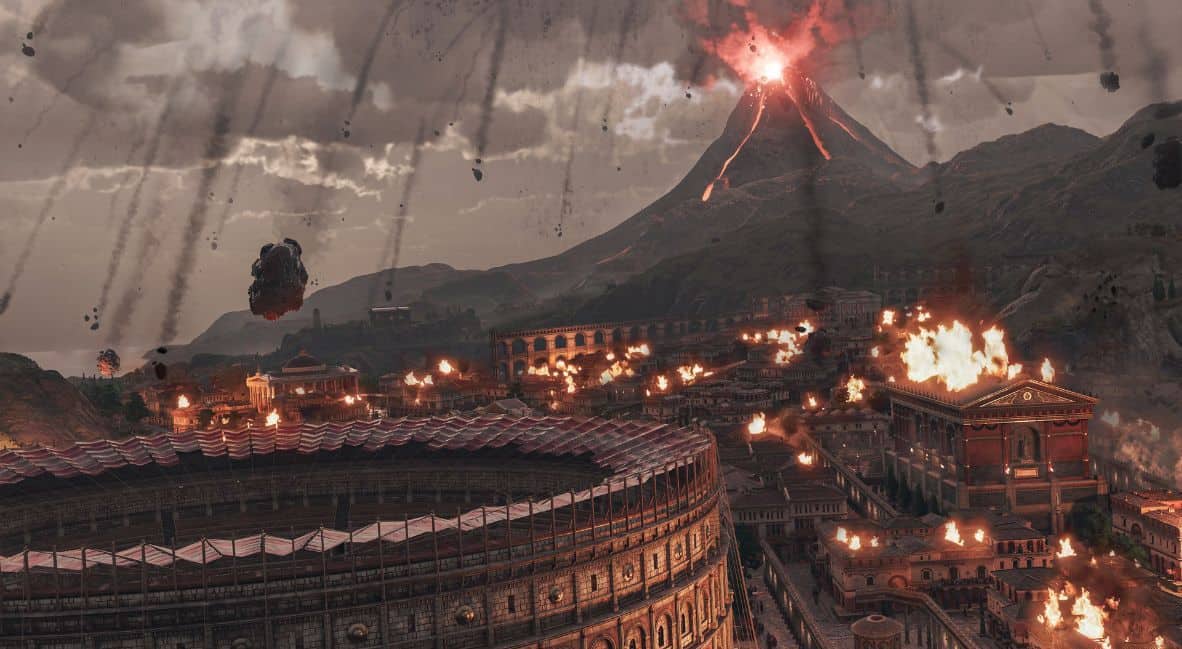
However, the promise of abundance is inextricably linked to the threat of natural disaster. The core premise of Prophecies of Ash is that building a Roman city in the shadow of a massive volcano is inherently risky. The visual evidence, showing giant rocks blasting out from the volcano and impacting city structures, confirms that the game mechanics will treat natural hazards as a primary gameplay element. This is a significant departure from previous Anno titles, where environmental challenges were often predictable or manageable through simple defensive measures. Here, the threat is systemic, echoing across millennia and demanding a complete re-evaluation of long-term city planning.
Balancing Prosperity Against Cataclysmic Risk
The central trade-off presented by Prophecies of Ash is the tension between unparalleled resource wealth and unpredictable geological instability. Players are given the opportunity to build a thriving, complex civilization on Cinis, utilizing the rich river systems and the unique properties of Obsidian. Yet, this very location—a volcanic island—is the source of the greatest threat. This creates a strategic dilemma: do you maximize your resource output in the most geologically active zone, or do you spread your population and infrastructure to mitigate the inevitable damage?
Ubisoft’s press release details several specific, high-impact mechanics that define this trade-off. These mechanics are not simply random events; they are cyclical, suggesting a deep integration into the game's simulated history. The primary hazards include: eruptions, volcanic winters, and the unique "bloom phase". Understanding how these three phases interact is crucial for any player aiming for long-term dominance. The trailer and source material suggest that the eruptions are the most immediate threat, capable of physically damaging buildings and disrupting supply lines with falling rock. These events force players to invest in resilient architecture and perhaps even specialized defensive infrastructure.
The impact of the cyclical mechanics is where the strategic depth truly lies. For instance, the source material suggests that the volcanic winter will severely hinder food production, forcing a rapid pivot from industrial expansion to agricultural resilience. Conversely, the "bloom phase" is hinted at as a period of agricultural overdrive, suggesting that the cycle is not purely destructive. This cyclical nature means that players cannot simply optimize for one type of output; they must optimize for adaptability. This is a major shift in gameplay philosophy, demanding that players maintain diversified resource stockpiles and flexible labor allocation to weather the inevitable swings between boom and bust.
Strategic Implications for Roman Governance
For veteran players of the Anno series, the introduction of these complex, multi-phase environmental mechanics represents the most significant challenge since the series’ inception. The game is no longer just about optimizing production chains; it is about managing a complex, living ecosystem that is constantly under threat. The Obsidian resource, while economically valuable, must now be viewed through the lens of risk management. If a major eruption disrupts the mining nodes, the entire specialized economy built around idols and boardgames could collapse, creating a cascading failure that requires immediate, drastic governmental intervention.
To succeed on Cinis, players must adopt a new approach to city planning. Instead of clustering high-value, specialized buildings near the most efficient resource nodes, a more dispersed, resilient model is required. This necessitates a complete rethinking of the supply chain, moving away from linear, single-source dependencies. The strategic focus shifts to redundancy and diversification.
The following points outline the key areas players must master to thrive in the volatile environment of Cinis:
- Resource Buffer Management: Maintaining large, diverse stockpiles of non-perishable goods (like Obsidian or processed materials) to survive periods of agricultural collapse during a volcanic winter.
- Infrastructure Resilience: Prioritizing building types and defensive structures that can withstand physical damage from rockfalls and seismic activity.
- Labor Flexibility: Implementing labor systems that can rapidly pivot workers from high-output, specialized industries (like Obsidian crafting) to essential survival roles (like farming or basic construction) when a crisis hits.
The integration of these mechanics means that the player's role is less that of a mere administrator and more that of a planetary governor, tasked with guiding a civilization through a geological epoch of extreme volatility. The most important unresolved signal for players remains the precise balance of these phases. While the source confirms the existence of the three phases—eruptions, winters, and bloom—the exact duration, severity, and mitigating factors for each remain details that will need to be learned through gameplay. Prophecies of Ash promises not just a new map, but a fundamentally deeper, more dangerous simulation of Roman life.
Confirmed details first, useful context second. This is the quickest path to the source trail and the next pages worth opening.
Source date: April 12, 2026