AMD’s $299 RX 9060 XT Hits a VRAM Wall That Should Scare Every Budget Builder
For $299, AMD promised a mid-range revolution, but the Radeon RX 9060 XT is proving that a low price tag cannot hide a massive architectural compromise. Early benchmarks reveal a card that trades blows with Nvidia’s best until it hits a VRAM ceiling that brings frames crashing down without warning.
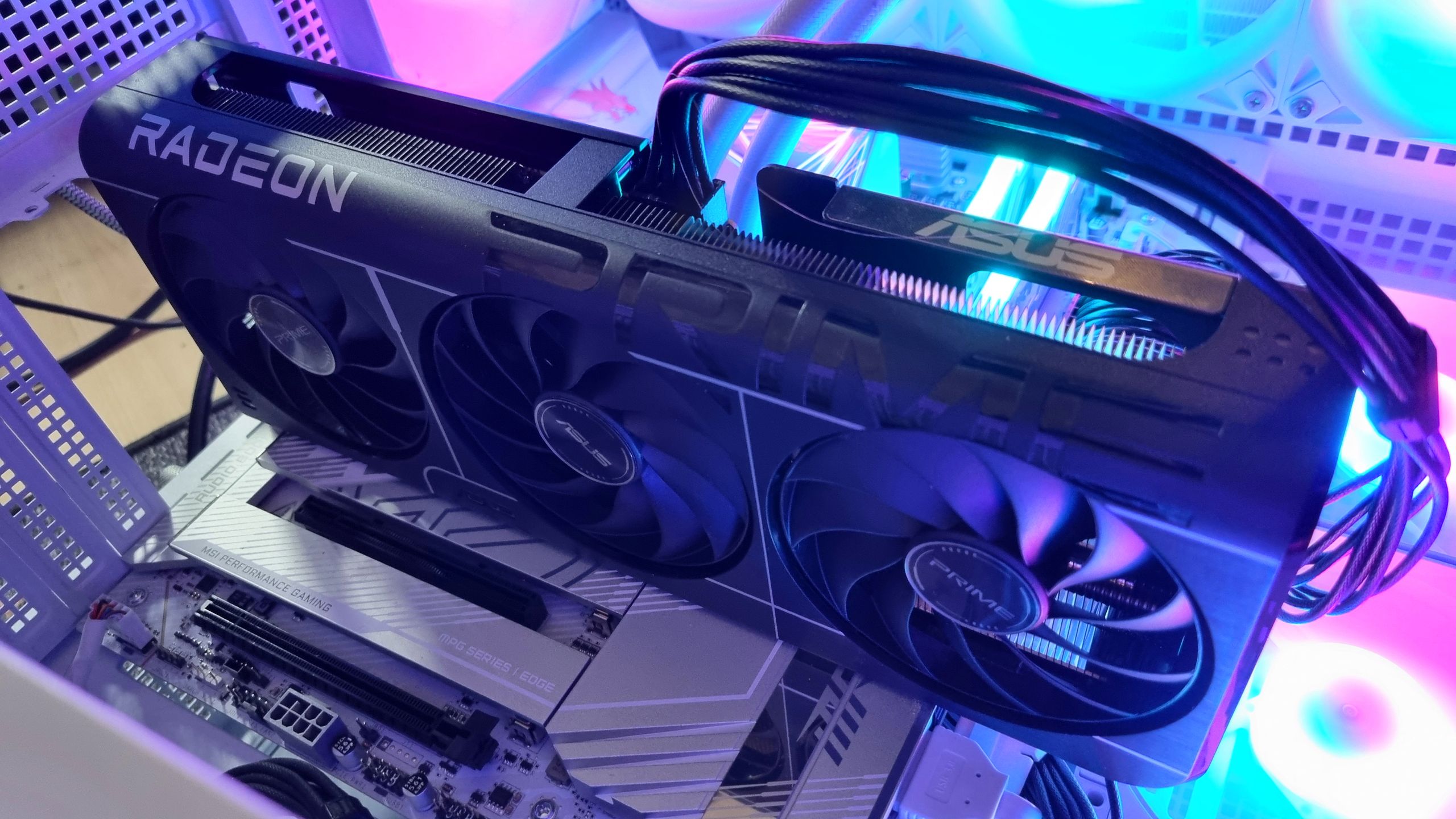
What this means for players: If you are building a PC for the next three years, the 8GB memory buffer on this card might be a ticking time bomb for your favorite AAA titles. While the MSRP looks attractive on paper, the real-world cost of inconsistent performance could be much higher than the $40 savings suggests.

AMD Radeon RX 9060 XT Thermal Efficiency
Engineering a card that fits into tight spaces without turning a chassis into an oven is where AMD actually found a win here. The Radeon RX 9060 XT 8GB is marketed as a highly affordable, current-generation GPU that prioritizes small form factor compatibility. Its thermal efficiency is a standout feature, making it a prime candidate for Mini-ITX builders who struggle with the bulkier heatsinks found on Nvidia’s high-end partner cards.
In specific scenarios, the architecture shines. During testing in Total War: Warhammer 3 at 1080p, the RX 9060 XT managed to outpace the RTX 5060 Ti 8GB by nine full frames. This is not a marginal lead; it is a clear demonstration that when the engine aligns with AMD’s silicon, the value-per-dollar ratio swings heavily in favor of Team Red. However, these victories are increasingly isolated as modern game engines demand more from the memory subsystem.
Cyberpunk 2077 Benchmarks Reveal VRAM Limits
The honeymoon phase for the RX 9060 XT ends abruptly when you load up Night City. In Cyberpunk 2077, running at 1080p on Medium settings with Ray Tracing enabled, the card achieved a modest 72 Avg FPS. This significantly trails the RTX 5060 Ti 8GB, which pushed 91 Avg FPS under the same conditions. The 19-frame gap represents a massive 26% performance deficit for the AMD card in one of the most played benchmarks in the world.
Technical data suggests the 8GB VRAM limitation is the primary culprit. Even at 1080p, modern assets and ray-traced lighting effects saturate the memory buffer, forcing the GPU to swap data constantly. This bottleneck turns a smooth experience into a sluggish one, proving that raw compute power cannot compensate for a lack of high-speed video memory in demanding scenarios. The card struggles significantly in VRAM-intensive games, and these issues only amplify as you push the settings higher.
Homeworld 3 Highlights Memory Capacity Issues
If there was any doubt about the impact of VRAM capacity, Homeworld 3 provides the definitive proof. When comparing the 8GB version of the RX 9060 XT against its 16GB sibling, the performance gap is staggering. The 8GB card averaged 75 FPS, while the 16GB version soared to 97 FPS. This 22-frame difference comes from the exact same GPU core, meaning the memory capacity alone is responsible for a nearly 30% increase in frame rates.
This benchmark is a wake-up call for anyone eyeing the $299 entry price. It shows that the silicon is capable of much more, but it is being choked by the 8GB buffer. For a current-generation card, seeing such a massive delta based solely on VRAM suggests that 8GB is no longer the "sweet spot" for mid-range gaming, even at 1080p. Builders are essentially paying for a high-performance engine that is limited by a tiny fuel tank.
Nvidia RTX 5060 Ti Price Comparison
The market positioning of the RX 9060 XT relies entirely on its $299 MSRP. In contrast, the RTX 5060 Ti 8GB sits at a noticeable price premium, usually retailing for $40 to $50 more. For many enthusiasts, that extra cash buys access to Nvidia's superior DLSS 3.5 suite and more stable performance in ray-traced titles. AMD is banking on the idea that budget-conscious builders will prioritize that $50 saving over the performance stability of the competition.
Performance consistency remains the biggest hurdle for the RX 9060 XT. In Cyberpunk 2077, the card recorded 1% Low FPS of 51, compared to the RTX 5060 Ti's 44. While a higher 1% low usually suggests better stability, the overall inconsistency across different game titles indicates potential stuttering issues and optimization hurdles. One moment you are leading in Total War, and the next you are falling behind by 20 frames in a sci-fi RPG. This volatility makes it a difficult card to recommend for those who want a "set it and forget it" gaming experience.
The RX 9060 XT will likely become a niche favorite for SFF enthusiasts who prioritize low power draw and thermals over raw frame consistency. However, as more titles follow the memory-heavy path of Homeworld 3, the 8GB variant risks becoming a relic of a previous era. Expect the 16GB model to eventually replace this version as the true standard for mid-range builds once prices stabilize.
Frequently Asked Questions
Is the RX 9060 XT 8GB enough for 1080p gaming?
It performs well in optimized titles like Total War, but struggles in VRAM-heavy games like Cyberpunk 2077. You may need to lower texture settings to avoid stuttering in future releases.
How much cheaper is the RX 9060 XT than the RTX 5060 Ti?
The AMD card retails at an MSRP of $299, which is roughly $40 to $50 less than the Nvidia equivalent. This makes it a strong choice for strictly budget-limited builds.
Does the 16GB version of the RX 9060 XT perform better?
Yes, in games like Homeworld 3, the 16GB version provides a nearly 30% performance boost over the 8GB model. The extra memory prevents the massive frame drops seen in modern VRAM-intensive titles.
Confirmed details first, useful context second. This is the quickest path to the source trail and the next pages worth opening.
Source date: April 17, 2026